Rising Corncrakes & Rewilding in Scotland
The latest news on nature and conservation in Britain.
National news
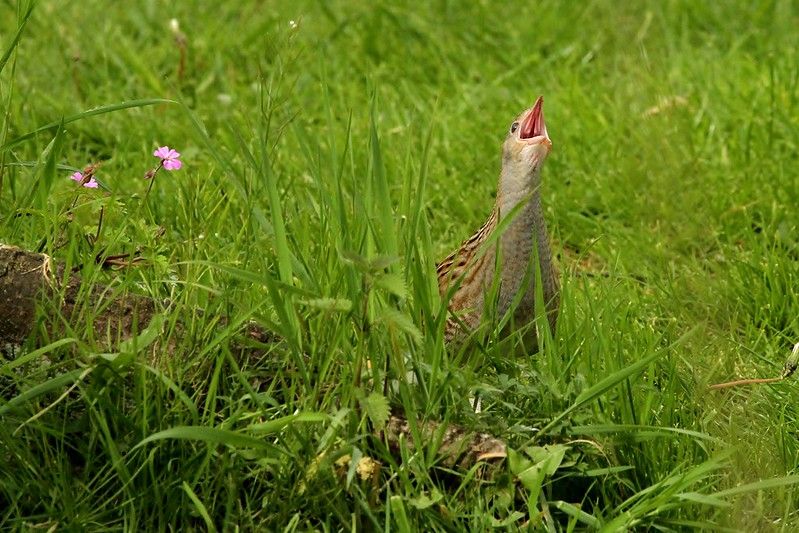
Corncrakes | The number of breeding corncrakes in Scotland has increased for the first time in five years. The RSPB’s annual survey recorded 870 calling males, an increase of 42 from last year and the highest number the population has reached since 2019. The charity said the increase was largely due to corncrake-friendly land management; in particular, the islands of Tiree, Coll and Lewis saw significant increases. During winter on the islands, livestock grazing is controlled in places to encourage vegetation corridors of irises, nettles and cow parsley, which the birds use as cover from predators. Director of RSPB Scotland, Anne McCall, said the results were “a real tribute” to the collective effort of farmers, crofters and communities to save the rare birds. The Independent, the Guardian and the Herald reported the news.
Roads | The Welsh government has launched a nature recovery action plan for the country’s road network. In the face of severe biodiversity loss, deputy climate change minister Lee Waters said the country must take “every opportunity to support nature”, starting with land owned around the road network. The strategy sets out actions including increasing habitat connectivity through corridors, minimising wildlife mortality on roads and developing alternative methods of weed control to eliminate herbicides. Separately, Swansea Council has approved a plan to protect and manage 30% of the county’s land and intertidal areas for nature by 2030. The Wales Herald and Wales Online reported the news.
Pollution | The government has abandoned its plans to end pollution rules for house building in England, reports the Guardian and ITV News, in a move that has been welcomed by campaigners. Levelling up secretary Michael Gove had been planning to scrap EU-derived ‘nutrient neutrality’ laws, which require developers to pay to offset pollution caused by house building. However, it is thought that the double byelection loss could have forced Rishi Sunak to reconsider his support, and the plans will no longer feature in the King’s Speech. The U-turn comes after Sunak was defeated on the same topic in the House of Lords in September, when the government tried to introduce an amendment to the levelling-up bill. Meanwhile in Dorset, the building of around 3,500 homes is being delayed by the very same regulations, reports the BBC.
Brilliant news! Well done to tireless @GreenJennyJones for leading the fight back in the Lords and to all the hard work by so many campaigners - is it too much to hope this marks the end of the govt using environment as part of its culture wars?? https://t.co/nMJVGegKjf
— Caroline Lucas (@CarolineLucas) October 20, 2023
In other news:
- Labour has reneged on its promise to introduce a Scottish-style right to roam in England if elected, reports the Guardian. In response, the British Mountaineering Council spoke out in defence of wider access rights.
- Scottish salmon producers want the word “farmed” taken off product labels, but environmentalists say the move would mislead customers, reports the Times and the Ferret.
- A report by an international team of scientists has found that 20 of the 35 planetary vital signs used to track climate change are at record extremes. The Guardian and the Independent covered the news.
- The UK government has responded to the Committee on Climate Change 2023 progress report here.
- Scottish farmers are struggling with the damage costs of Storm Babet flooding, reports the BBC.
- Meat consumption in the UK is at its lowest level since records began in the 1970s, likely due to the cost of living crisis, reports the Guardian.
Across the country
Perthshire | The Durrell Wildlife Conservation Trust, based in Jersey, has announced plans for an enormous rewilding project based in Scotland. The Dalnacardoch Estate, which is mostly within the Cairngorms National Park, was purchased earlier this year by a family foundation with the express purpose of leasing it to the Trust for a rewilding project. The 100-year project includes the recovery of the capercaillie and a transition away from the use of the land as a sporting estate. “We look forward to restoring the plant and animal communities of Dalnacardoch so that the glens and moors are vibrant with bird song and pulsing with life,” said Professor Carol Jones, the Trust’s chief scientist. Ecological audits of the land are already underway. The BBC, the National and the Herald covered the story.
Wye | A judge at the High Court in Cardiff has granted a judicial review into how the Environment Agency enforces agricultural pollution laws. Anti-pollution charity River Action brought a legal case against the EA, claiming that it was allowing excessive amounts of organic manure to pollute the River Wye. In excess, the phosphorus contained in manure causes extensive algal blooms which suffocate aquatic plants and wildlife. The EA has a legal duty to enforce laws known as the “farming rules for water”, but the court heard that differences between the written law and the guidance from the secretary of state have led to illegal actions going unpunished. The review is expected to take place in 2024. The BBC and the Shropshire Star reported the news.
Sussex | Conservationists are preparing to return the black-veined white – a butterfly lost from the UK in the mid-1920s – to a 100-mile corridor linking Ashdown Forest in East Sussex to the coastline, reports the Times. The butterfly garnered headlines earlier this year following an unregulated release to a nature reserve in Croydon, to the frustration of many conservationists. This time, however, everything is above board. The first job of the Weald to Waves project is to secure funding, and then to source eggs or larvae that are free of pathogens and parasites from an area of Europe where the flying season is synchronous with the UK’s. Only then can the butterflies start to take flight, with the warmer climate working in its favour. “We know enough about why it died out and its requirements to give reintroducing it a really good go,” says Matthew Oates, an advisor to the project. “Now is the time, so we’re going for it.”
Elsewhere:
- Seabirds have had a “very successful” breeding season on the Cumbrian coast, reports the BBC.
- The construction of leaky dams, resembling those of beavers, in Shropshire held back millions of litres of water during storms, reports the Shropshire Star.
- Dorset police have launched a criminal investigation following the destruction of a woodland by developers, reports the Times.
- Marine scientists at the University of Portsmouth have attached metal cages containing oyster shells and hessian rope to Ryde Pier to encourage biodiversity, reports Portsmouth News.
- Once again, thousands of dead molluscs have washed up on a Teesside beach, reports Teesside Live.
- A thousand juvenile oysters have been introduced to a harbour in the Isle of Wight, reports the BBC.
- White-tailed eagles have bred successfully in Caithness for the first time in a hundred years, reports BirdGuides.
- Descendants of hazel dormice, released into an ancient woodland in Cambridgeshire in the 1990s, are still going strong, reports the Times.
- Some 30,000 more trees are to be planted across Cardiff over the next six months, reports Herald.Wales.
- A pair of marsh hen harriers has bred successfully in north Cornwall for the first time since the 1860s, according to the Cornwall Wildlife Trust.
- A survey conducted by Bangor University shows that the majority of people in the UK would welcome more trees and wildflower meadows in their local area.
- Natural England has opposed its own plans to build a car park and access road in a nature reserve on the Lizard Peninsula, reports Cornwall Live.
- A major restoration project is taking place on Darwen moor to rewet its peatland by creating leaky dams, reports the Lancashire Telegraph.
- Military personnel are helping to boost biodiversity on sand dunes at Penhale, Cornwall, by removing overgrown scrub. Meanwhile, a separate military project has restored an area of wetland on the River Avon in Wiltshire.
- The Hebridean Whale and Dolphin Trust has collated a digital catalogue of photographs of minke whales, providing insight about the threatened species. It includes one individual, Snowy, which has set the European sightings record, reports the BBC.
- Over 2,000 people have signed a petition to save 160 trees in South Shields from being felled, reports the BBC.
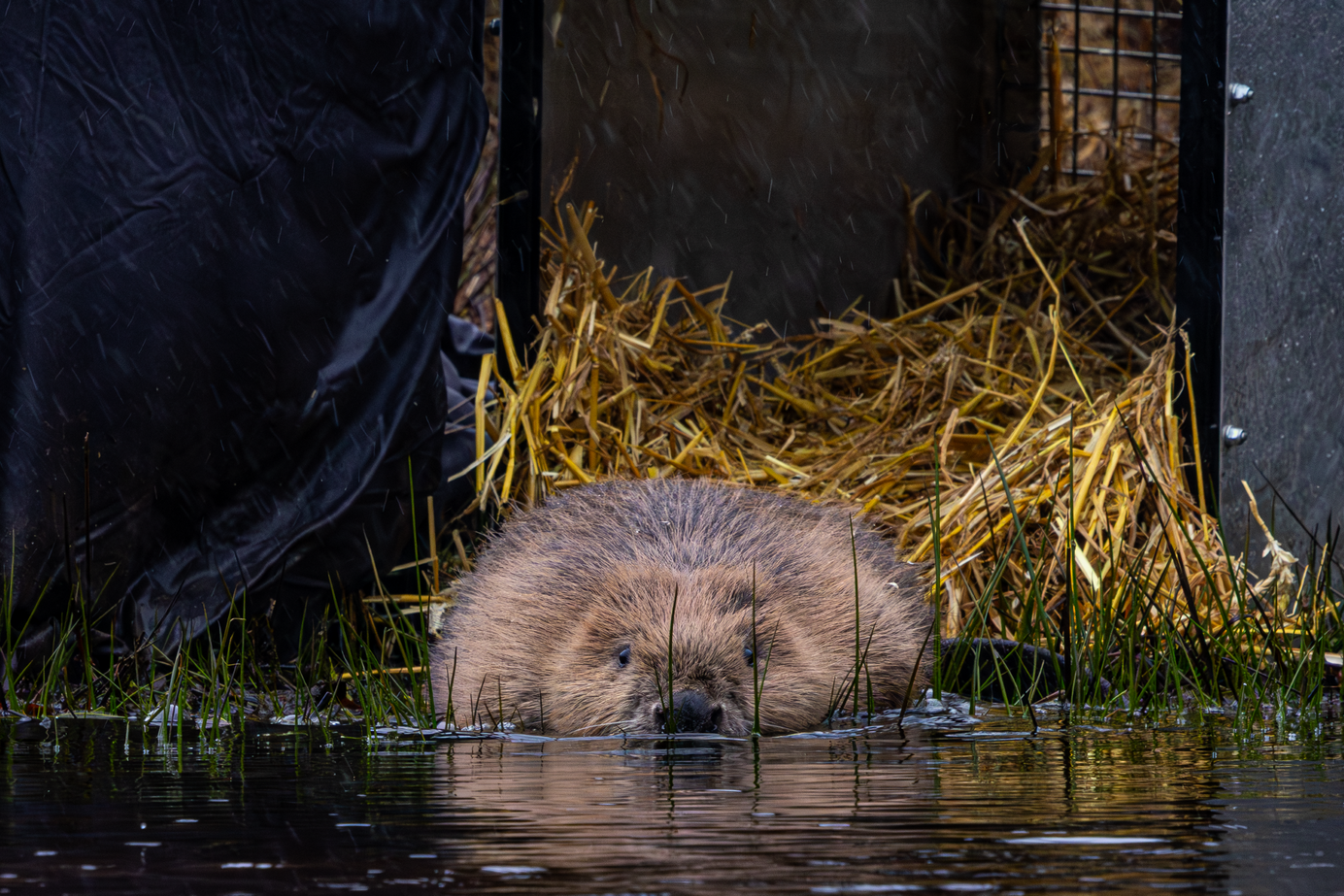
- Forestry and Land Scotland has delayed plans to reintroduce beavers to Glen Affric due to landowner opposition, reports the Ferret.
Reports
Deforestation | WWF has criticised the UK government for failing to show leadership on reducing deforestation. The 2023 Forest Declaration Assessment found that the rate of global deforestation accelerated last year. It revealed that 6.6m hectares of global forest were cut down in 2022 – 21% higher than it should have been to remain on track for reaching the COP26 target of halting deforestation by 2030. WWF launched a report alongside the assessment, outlining recommendations for countries to get back on track. It calls on the UK government to establish a due diligence system to cut deforestation out of supply chains – a measure included in the Environment Act but not yet enacted. To accompany the report, WWF collaborated with the University of Reading to create the Forest Stripes, showcasing the crisis facing global forests in one striking image. The Times covered the news.
Accessibility | A research report by Natural England looks at how to improve access to green and blue spaces for people with visual impairments. Researchers conducted a survey with more than 750 people with disabilities, followed by two focus groups. The results highlighted a range of critical challenges, including a lack of key information, the absence of accessible public transport and challenges to navigation. The report recommends a range of actions to address these issues, including creating more facilities and offering organised activities. Facilitating easier access to nature is particularly important, according to the authors, because the number of individuals experiencing sight loss is projected to rise due to an ageing population.
Racoons | Over 170 new species could arrive in Scotland in the coming years, with potentially disastrous impacts on the country’s native wildlife. This is the finding of a “horizon scanning” report by the UK Centre for Ecology & Hydrology and NatureScot, commissioned by the Scottish government, focusing on the spread of invasive species. Freshwater ecosystems are particularly vulnerable due to other pressures, including climate change and sewage, while the promotion of tourism in northern Scotland has increased the chances of new arrivals as non-natives hitchhike on the cars and clothes of travellers. The Times covered the research, focusing on one of the more charismatic – but no less damaging – possible arrivals: racoons. “They will be very bad for water birds and seabirds because they track the eggs and chicks. They’ll compete with pine martens and will attack capercaillie and grouse eggs,” said Richard Broughton, one of the authors of the report.
Science
Bird Flu | Scientists have found evidence that a portion of seabirds are developing immunity to bird flu. Preliminary research by a consortium led by the Animal and Plant Health Agency investigated small sample sizes of northern gannets and shags. They took blood samples from birds on Bass Rock – the world’s largest gannet colony – and found that 30% had antibodies. This confirms earlier observations by conservationists, who noted that the normally blue irises of gannets which survived the flu subsequently turned black. It is unknown how long the effects of immunity last, and the team has secured £3.3m in funding for further research into transmission. The findings were published in Ibis, and covered by the Guardian.
Bumblebees | Bumblebees prioritise gathering maximum calories over energy efficiency while foraging, according to research published in iScience. For six months, researchers studied the feeding patterns of Bombus terrestris, one of the most common bumblebees in the UK. They watched individual bees for up to eight hours a day, and made 60,000 behavioural observations. They found that unlike honeybees – which optimise their individual energy expenditure – bumblebees will collect the most sugar in the shortest possible time, to provide immediate energy to the colony. Dr Jonathan Pattrick, co-author of the study, said the results could help inform the choice of flowers planted in field margins, as well as crop varieties that are “better” for bumblebees. Phys.org summarised the results.
Turtle Doves | There are currently just 2,092 turtle dove territories in the UK, down from an estimated 125,000 in 1970, making it the country's fastest declining bird species. That is the depressing finding of a new study, published in Bird Study, and led by scientists at the RSPB. It is the first national survey of turtle doves to be undertaken in the UK – which is not to say that the birds were previously unmonitored, but rather that their numbers have now dropped so low that the previous approach could no longer produce robust population trends. These days, the birds are concentrated in southeast England, with two-thirds occurring in just three counties: Kent, Suffolk and Essex. However, the recent ban on hunting the birds along the western flyway, through France, Portugal and Spain, now provides a vital opportunity for their recovery. A blog by the RSPB spells out the findings in more detail.
UK Turtle Dove Survey results are grim reading. 2021 survey estimates 2,092 territories, down from 125,00 pairs in 1970. Atlas data reinforce the sense of loss. Survey by @Natures_Voice, @ukrbbp, @KentishPlover with support from @_BTO and @NaturalEngland https://t.co/uJRwl2A6xS pic.twitter.com/OnifUYDSjL
— BTO (@_BTO) October 19, 2023
Driftwood
Stone Age | Here is one way to make a canoe trip down the Thames a bit different: do it in an animal skin vessel, dressed in buckskin, sleeping on reindeer fur and relying on nut flours and foraged plants for sustenance. This is how two experimental archaeologists, Theresa Emmerich Kamper and Sarah Day, decided to make the journey, in an attempt to better understand the lives and needs of Paleolithic people. But the greatest challenge came not from their natural materials – although they weren’t without their difficulties – but from the more recent changes to the landscape, including prohibitions on camping and lighting fires and the locks that punctuated their course. “It's funny because all the real issues we've run into have nothing to do with the fact that the Stone Age was hard,” Emmerich Kamper said. “It's that we're on a modern river.” The feature was published by BBC Travel.
Land | The Financial Times has gone all out with the graphics in a feature on the pressures facing UK land as the government attempts to meet both its climate and biodiversity targets while also maintaining a secure food supply. The article provides a helpful, if data-heavy, summary of the latest research on how the country might meet these goals, including a study from the RSPB that was published earlier this week in the journal One Earth. In addition to all the statistics on land use, there are a number of case studies, focusing on how farmers in Wales are dealing with competing demands in real life. The overriding message is that the government’s lofty goals are being undermined by its lack of systemic thinking: “If this isn’t something that requires joined-up government, I don’t know what is,” said Timothy Lang of City University.
Knepp | The Knepp Estate now has a restaurant – and it is run by Isabella Tree’s 26-year-old son, Ned Burrell. In an interview with the Financial Times, he explains how they have designed a culinary experience that ties in with the ethos of the renowned rewilding project. That obviously starts with the food – the menu features meat from the Old English longhorn cattle and Tamworth pigs that maintain the savanna-like landscape of the estate, and which are culled once a year at its on-site butchery, as well as vegetables from the neighbouring Knepp Market Garden. But it also extends to the furniture, including tables made from the wood of ash trees that were cleared due to dieback. “Healthy soil creates rich and complex flavours,” explains Burrell. “You can see it, smell it and taste it.”
Further reading:
- For anyone still following the war of words about food production between George Monbiot and Chris Smaje, here’s the latest essay from the latter.
- The BBC covers attempts by conservationists to save the lichens growing in Britain’s temperate rainforests.
- Carbon Brief has published an explainer about how climate change intensified toxic algae on Lough Neagh, the UK’s largest lake.
- In another Carbon Brief piece, Oxford researcher Sophus Zu Ermgassen writes about how to fix the gaps in England’s biodiversity net gain policy.
- Ever wondered what the bottom of Loch Lomond looks like? Find out here.
- The Guardian has two articles on tree protection: an editorial argues that planting trees is a “gift to the future” but ancient trees must not be overlooked, while this article reports on campaigns to better protect the country’s arboreal heritage.
- On radio, Chris Packham described the iconic Glen Coe landscape as “sad” and “broken”, and said it could be fixed through rewilding, reports the BBC and the Times. Separately, the presenter has launched a ‘shoestring’ wildlife series on YouTube, reports the Guardian.
- A feature on ITV News describes the preservation of the "Llanerchaeron Peach", a rare apple variety found in only six locations in the UK, including a walled garden in Ceredigion.
- The Guardian has collated some of the best pieces by John Vidal, former environment editor, who has died aged 74.
- Country Living has a list of 23 books to help readers reconnect with nature.
- A man in Stirlingshire managed to film the “weird anomaly” of Storm Babet winds lifting an entire section of forest floor. Watch it here on the Guardian.
- After walking 180 miles across England’s lowlands, Charlie Gardner writes a feature in the Byline Times questioning when the sea will claim these low-lying areas.
- A feature in the Guardian looks at how rewilding projects across the UK are helping to boost populations of endangered species.
Happy days
Trees | In light of the felling of the sycamore gap tree, Countryfile has produced a rundown of the six most beautiful lonely trees in Britain, including a giant oak within a field of rape seed in Oxfordshire, and a much smaller oak on a tiny island in Loch Lomond. If you are still hungering for stories of lonely trees after that, then be sure to check out our recent feature on Britain’s loneliest rainforest – we were delighted to receive a letter from a reader, soon after publishing the story, telling us about her journey to seek it out for herself!

Subscribe to our newsletter
Members receive our premium weekly digest of nature news from across Britain.
Comments
Sign in or become a Inkcap Journal member to join the conversation.
Just enter your email below to get a log in link.