Local Nature Recovery & Stone Age Oysters
The latest news on nature and conservation in Britain.
National news
Strategy | The West of England authority has published its Local Nature Recovery Strategy: the first in a series of 48 which will cover the whole of England, as required by the Environment Act. The publication has been called a ‘watershed moment’ for collaborative efforts to restore nature on a larger scale in the UK. It is the product of work between local authorities, government agencies, NGOs and the community, which sets out the regional priorities for nature recovery and provides guidance for those looking to contribute. A particularly neat feature is the online toolkit, in the form of an interactive map, which allows users to search by area for relevant actions such as habitat creation or wildlife-friendly gardens. The launch of the strategy was accompanied by nine ‘priority programmes’ which will target key areas, from the Western Forest and urban nature to restoring rivers and returning species. ENDS reported the news.
COP | COP16 has drawn to a close in Cali, Colombia, with an ‘anti-climatic’ finish. Governments failed to agree on crucial points including nature funding from wealthier countries, and how this decade’s targets would be monitored on a global scale. Catherine Weller, director of global policy at Fauna & Flora, said that, two years on, the ‘vast majority’ of targets agreed in Montreal ‘still feel like unfunded words on paper’. However, the summit did make some progress, including a global levy on companies using genetic data from nature, stressing the link between biodiversity and climate, and formally incorporating Indigenous communities into the UN’s decision-making process on biodiversity. The news was widely covered, and the RSPB published its reflections here.
Farming | The Prime Minister has told MPs that the ‘vast majority’ of farmers won’t be affected by the changes to inheritance tax announced in the budget, after widespread outcry over the measure. Under the changes, inherited agricultural assets worth more than £1m will be liable to the tax at 20% (half the usual rate). The National Farmers’ Union called this ‘disastrous’ for family farms, saying it will ‘snatch away the next generation’s ability to carry on producing British food’. Meanwhile, a group of around 50 farmers gathered in Hexham, Northumberland, to protest the changes, which one described as an ‘attack’ on ‘the rural community’. The BBC reported the news, and this BBC Verify article estimates the number of farms affected is likely to be around only 500 per year. Meanwhile, a leading article in the Times argues that farming is ‘crucial to this nation’s economy, heritage and cultural identity’, and ‘does not deserve to be battered by a harsh budget’.
In other news:
- Sunday saw 15,000 protesters take to the streets of London to demand immediate action over sewage spills. The Times and the BBC covered the news, and the Wildlife Trusts posted its reflections here.
- The Scottish government is to develop an ‘ecosystem restoration code’ to help deliver nature restoration and biodiversity initiatives, according to its newly published Natural Capital Market Framework, reports ENDS.
- Environmentalists have celebrated an update to the Crown Estate Bill which will require the body to consider UK targets on climate change, adaptation and nature. Read more in the briefing for report stage by the Wildlife and Countryside Link.
- Defra has abandoned publication of its promised chalk stream recovery pack, according to a blog by conservationist Charles Rangeley-Wilson. The alleged news received criticism on X.
- A report by NatureScot has shed light on the distribution of Scotland’s threatened sharks, rays and skates.
- Nature campaigners are calling for taxpayers to take stakes in forest and peatland carbon capture projects to avoid all the profits going to private investors, reports the Guardian.
Across the country
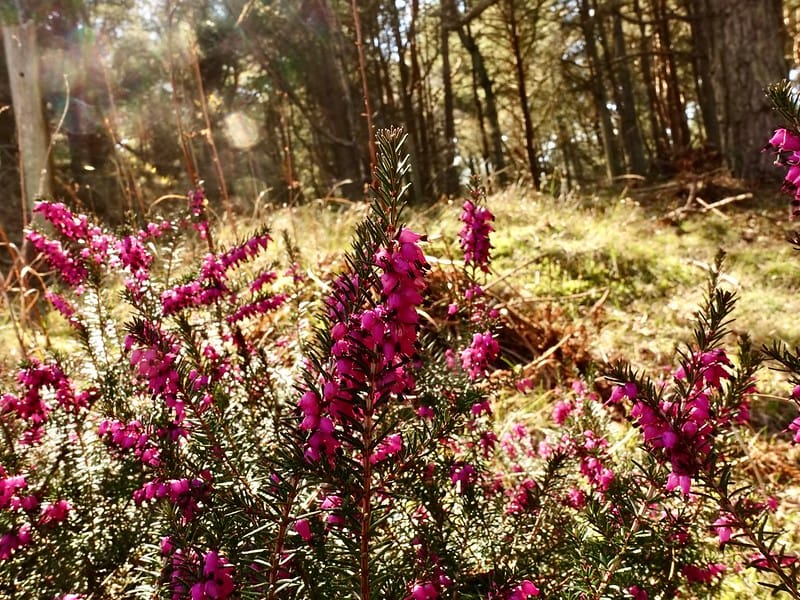
London | A rare species of native heather has been reintroduced to Epping Forest in north London after it disappeared more than 50 years ago. Bell heather is a delicate heathland species with dark purple-pink flowers, which thrives on dry, free-draining acid heathland. Its specific habitat needs, combined with issues like air pollution, means it has struggled to survive in the east of England. Today, the species is only found at one site in Essex, at Tiptree Heath reserve near Colchester. A project spearheaded by botanist Paul Fletcher trialled numerous propagation methods before successfully transferring 80 healthy heather plants to Epping by way of root cuttings. Dr. Jeremy Dagley of the Essex Wildlife Trust said the case highlighted the vital role of small nature reserves in preserving biodiversity, adding: ‘I think the small, giving to the big – it's a nice touch.’ The BBC reported the news.
Canna | The National Trust for Scotland has recorded a ‘promising’ increase in the corncrake population on the island of Canna in the Inner Hebrides. Corncrakes are found in north and west Scotland, but numbers have plummeted in the last decade due to intensive agriculture. Now, rangers have counted at least 12 to 14 calling males on Canna – a huge increase compared to one or two in previous seasons. The Trust attributes this rise to the high-value nature farming practices on the island, which includes five areas of farmland designated for corncrakes. For example, in summer, mixed livestock grazing combined with no mowing provides areas of undisturbed cover for nesting birds. The Trust’s aim is to continue working with crofters and farmers to increase Canna’s population to 50 calling males. The BBC and the Herald reported the news.
Chester | One of the UK’s largest species of spider is having a record mating season, ten years after a breeding programme by Chester Zoo helped save it from extinction. The fen raft spider can be found in unpolluted aquatic ecosystems including fens and bogs, but 15 years ago there were few left due to habitat loss. Chester Zoo, in collaboration with the RSPB, came to its aid, raising hundreds of baby spiders in test tubes and hand-feeding them with tweezers until they were large enough to be released. Now, the RSPB estimates that there are 10,000 breeding female fen raft spiders across the UK, in what is described as a ‘huge conservation success’. The BBC and the Guardian reported the news, while Chester Zoo celebrated on X. In other news, the Zoo has also announced that it is rebranding to focus on conservation. The Drum and Creative Boom reported the story.
Elsewhere:
- Derby City Council has welcomed a herd of 11 cattle – a mix of Highland and Shorthorn – to graze the city parks over winter, reports the BBC.
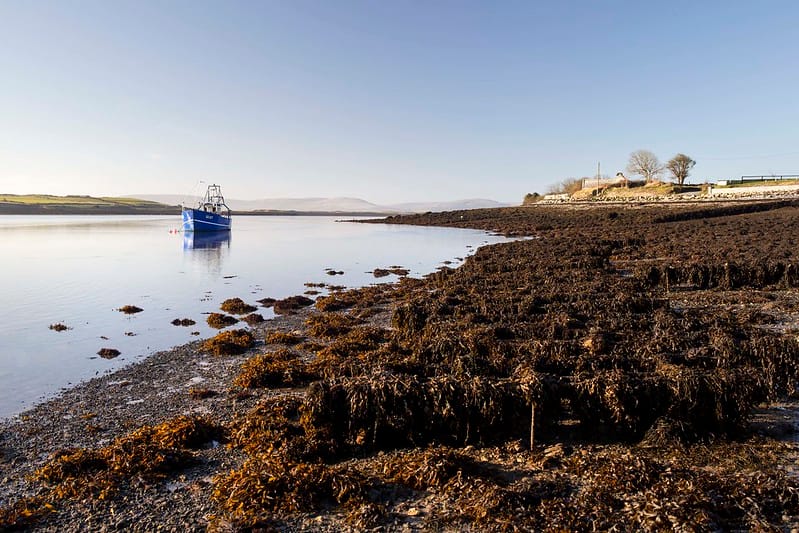
- Scotch whisky giant Glenmorangie is celebrating a 10-year environmental partnership which has just returned its 100,000th oyster to the Dornoch Firth, reports the Herald.
- The Avon Wildlife Trust is attempting to diversify the ‘dull’ woodland at Goblin Combe in North Somerset to benefit bats and dormice, reports the BBC.
- Natural Resources Wales has completed work to reinstate the natural path of the River Ely in the Vale of Glamorgan, thereby restoring important riparian habitat.
- Residents of Jersey are being asked to identify special areas of the island to help with its application to become a UNESCO Global Geopark, reports the BBC.
- A breeding project to restore Scotland’s population of medicinal leeches has welcomed its first babies at the Highland Wildlife Park near Kingussie, reports the BBC.
- The Manx Wildlife Trust is searching for a team of conservationists to live and work on a remote bird observatory on the Calf of Man, reports the BBC.
- Natural Resources Wales has given the green light for a project to introduce grazers onto 280 hectares of peatland in Pembrokeshire.
- Farmers and tenants local to the Rothbury estate in Northumberland are asking the new owners – the Wildlife Trusts – to work with rather than against them, reports the BBC.
- A coalition of nature charities is standing against plans to build a golf course on the biodiverse site of Coul Links on the east coast of Scotland, for the second time in ten years.
- Jersey Zoo has created a bat-friendly garden to support local species, reports the BBC.
- Powys county councillor Elwyn Vaughan has said that proposals for a new national park in Wales would turn the area into a ‘play area for townies’, reports the Shropshire Star.
- A golden eagle has been found dismembered and left in a plastic bag in Stirlingshire, reports the Times. Meanwhile, a red kite was found after being poisoned by pesticide in east Sutherland, according to the RSPB.
- A Sowerby’s beaked whale, which is rarely seen at sea, has washed up at Weymouth, Dorset, reports the BBC. Meanwhile, a humpback whale which became entangled in creel lines has been set free in Loch Fyne.
- Conservationists on St Agnes in the Isles of Scilly are concerned by evidence that there may be a mouse on the island, endangering its colony of seabirds, reports the BBC and the Telegraph.
- Scientists in Worcester are using drones to learn more about soil erosion in farmers’ fields, reports the BBC.
- The cost of building a ‘bat shed’ to protect a colony of Bechstein’s bats roosting in woodland along the HS2 line has risen to more than £100m, reports the Guardian.
- ‘Feed the Birds’, a befriending service in Shropshire which uses bird feeding to tackle loneliness, has received £19,000 to expand, reports the BBC.
Reports
Crime | Convictions for wildlife crime have dropped to an all-time low over the past seven years, according to a report by Wildlife and Countryside Link. Its annual crime report reveals that there were 4,735 incidents reported in 2023, yet only 456 convictions: down from 900 in 2021, and 2,678 in 2017. Since 2017, wildlife crime has been prosecuted at a rate of 2.1%, which is less than a third of the average for all crimes. The authors write that this is ‘perhaps not surprising’: ‘There is still a perception that wildlife crimes matter less than other crimes, and this feeds through into limited resourcing.’ The group’s foremost recommendation is to make key wildlife crimes notifiable – meaning police officers must inform the Home Office – but it also calls for regular funding for specialist units, and training for other police forces and prosecutors. The Mirror reported the news.
Community | The Wildlife Trusts has finished work on ‘Nextdoor Nature’, a £5m two-year programme working with marginalised communities to connect with nature on their doorstep. An evaluation report, Power to the People, outlines the impact of the programme across more than 1,600 communities in the UK. Some 95% of participants said that there was greater collaborative working between residents and local groups as a result of the project, while 82% felt there was greater decision-making about wildlife in the hands of locals. The report details example projects across the country: linking schools with rare bird reintroduction schemes in Kent, food growing with a Quaker community, wildlife gardening with Roma communities in East Belfast, and creating nature connections in a blind community, to name a few. Read more here.
Birds | The latest annual report of the Rare Breeding Bird Panel reveals that 2022 was an almost record-breaking year for the number of rare birds breeding in the UK. The report says that 108 species of rare birds attempted to breed that year – three less than in 2021, the highest total since the Panel began reporting in 1973. This reinforces the trend of increasing numbers of rare birds in the UK, largely driven by the arrival of colonising species. For example, 2022 saw the first confirmed breeding of glossy ibis, a species once only found on Mediterranean coasts. Meanwhile, four other recent colonists reached record levels, including the Eurasian spoonbill, Mediterranean gull, and two types of egret. Other notable findings include recovering populations of three types of raptors, and the impact of avian flu on seabirds. The RBBP summarised the findings on X, and the JNCC also has a write-up.
Science
Oysters | Environmentalists attempting to restore oyster stocks today can look to the distant past for lessons on sustainability, according to a study in PNAS. Researchers from the Leibniz Centre for Archaeology and the University of York have found that prehistoric communities in southern Scandinavia harvested oysters sustainably for more than three millennia. Using 19 archaeological sites on the Danish coast, the study analysed more than 2,000 European oyster shells dating from circa 5,660 to 2,600 BCE. The results show that oyster populations were not overexploited during the Mesolithic and Neolithic periods, despite increased harvesting pressure. Instead, communities practised sustainable harvesting methods that enabled long-term ecological stability – a valuable insight on resource management for modern conservation efforts, according to the authors. Phys.org covered the findings.
Bats | The international trade of bats for medicine and food is a well-known threat to various species, but less is known about the online trade in bat taxidermy and specimens. To examine this emerging threat, researchers from the University of Sussex analysed trade across two major e-commerce platforms – eBay and Etsy – over an 18-month period. They found that, across 40,000 relevant results, 47 bat species were listed for sale, of which 32 are not currently identified by the IUCN Red List as traded for any purpose. The highest number of listings came from the US, UK and Hong Kong, while traded species predominantly originated in southeast Asia. The authors highlight the danger of online demand driving exploitation, especially for popular species which occur at low densities, such as the painted wooly bat. The findings are published in Biological Conservation.
Fibres | Bio-based materials could pose a greater threat to the natural environment than the plastic fibres they are intended to replace. This is the main finding of a study by the University of Plymouth, published in Environmental Science and Technology. Researchers tested two bio-based fibres – viscose and lyocell – on earthworms, a species critical to soil health globally. They found that, in high concentrations of fibres, 30% of earthworms died after 72 hours of exposure to conventional polyester, while those exposed to bio-based fibres experienced much higher mortality rates: 60% for lyocell, and 80% for viscose. Lower densities of the bio-based products also had negative impacts on reproduction and growth. The authors say that the results highlight the complex nature of efforts to reduce microplastic pollution, and the importance of thoroughly testing new materials marketed as alternatives.
Driftwood
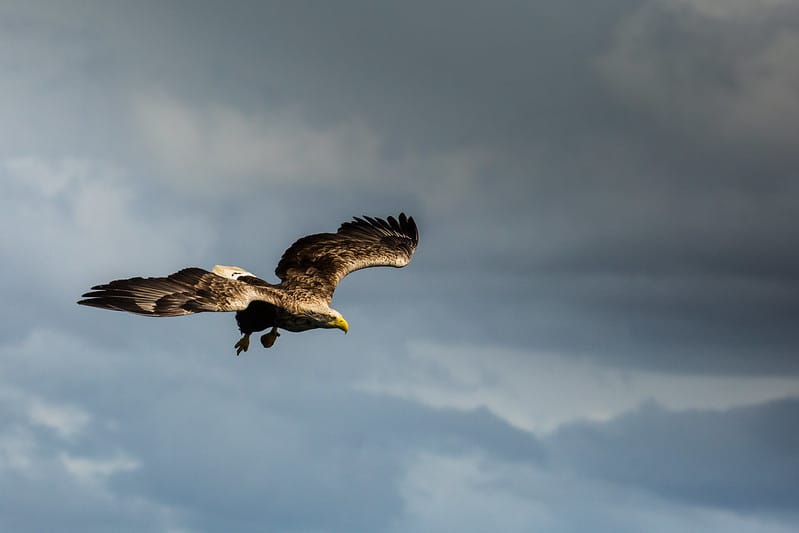
Eagles | Reintroducing sea eagles to the UK comes with a few difficulties, one of which is: how to look after young eagles without them becoming overly attached to humans, thus endangering their release into the wild? The team behind a project to restore sea eagles to the Severn Estuary thinks they have an answer. The handlers will all wear long robes, and feed the young eagles only using bird hand-puppets. ‘They can never see you,’ says Eric Heath, who is in charge of bringing the eaglets to the UK from Norway. ‘You have to disguise your human form at all times.’ This is just one of the measures being taken by the team, which is hoping to return the iconic raptor to the Severn by 2026 – more than 150 years after it last flew over the estuary. Read more about their efforts in this Guardian feature.
Gardens | With COP16 drawing to a disappointing close, official action on biodiversity might seem uninspiring – but a feature in the Financial Times finds hope from a different source. A new generation of garden ecologists is leading the way with on-the-ground audits and advice to boost habitats and nurture wildlife, according to writer Clare Coulson. The trend of the ‘garden biodiversity audit’ perhaps began with Fergus Garrett, head gardener at Great Dixter in East Sussex, who launched a full survey of the 30-acre estate over two years, recording 2,400 species. Coulson writes: ‘If ecologists had previously thought there was little of value in a highly cultivated garden, they quickly woke up to the garden’s potential as a nature reserve.’ Now, the message is spreading with the help of social media, where designers and biodiversity-focused gardeners are fuelling interest in wildlife-rich gardens and providing real-time advice.
Seagrass | An ‘underwater sea blaster’ might sound like something from a sci-fi novel, but in fact it is being tested by the Ocean Conservation Trust as part of its efforts to revolutionise seagrass conservation in the UK. Seagrass is an extremely valuable and biodiverse habitat in British waters, but restoring it by hand is slow and inefficient. To help with this, the Trust is trialling new methods of planting, as well as mapping and monitoring the healthy areas of habitat. The ‘sea blaster’ is actually a purpose-built seed-firing mechanism capable of planting 2,000 seeds in 20 minutes. Alongside the blaster, the Trust is also using a custom-built Remote Operative Vehicle (ROV) to produce high-resolution photogrammetry, enabling underwater mapping in ‘unprecedented detail’. You can read more about the technological advances supporting seagrass conservation in the Oceanographic.
Further reading:
- For the Times, singer-songwriter Ellie Goulding writes about the depletion of nature and why it is imperative to take action now.
- A commentary in the Guardian asks why the presidential election has been strewn with dead animals, from squirrels to whales and bears. Meanwhile, analysis by Carbon Brief suggests that Trump’s victory could add four billion tonnes of carbon to US emissions by 2030.
- A BBC article looks at the disproportionate environmental impact of dyeing clothes, and the UK start-up looking to change the game.
- Next week, National Geographic will air a documentary about the bond between a Shetland resident and an otter. Read about it in the Guardian.
- Also in the Guardian, this feature explores the underwater realm of plankton, and how scientists are using new technology to sequence its DNA.
- A BBC feature spotlights the spectrum of life found around Wales’ coastal piers, from wildlife spotters and anglers to arcade enthusiasts and roosting starlings.
- A book review for biologist Paul Ehrlich’s new book Before They Vanish argues that hope is more useful than its ‘pessimistic portrayal’ of species extinctions. Read the review in Nature.
Happy days
Song | South London-based musician Alice Boyd is set to release her second EP, Cloud Walking, later this month, which is inspired by the pioneering Scottish nature writer Nan Shepherd. The collection of songs draws on Boyd’s trip to the Cairngorm mountains last year, where she joined a group of eight women on a four-day expedition to retrace the footsteps of Shepherd and explore her seminal work, The Living Mountain. The collection blends folk-inspired harmonies with chamber pop instrumentation and field recordings captured during the journey. Boyd said: ‘I wanted Cloud Walking to reflect not just the physical journey of traversing the mountains, but the inner journey as well. Nan Shepherd’s writing encouraged us to appreciate the mountain for more than just reaching the top.’ You can listen to the songs on Soundcloud, and watch ‘O The Sun’ on Youtube accompanied by illustrations.

Subscribe to our newsletter
Members receive our premium weekly digest of nature news from across Britain.
Comments
Sign in or become a Inkcap Journal member to join the conversation.
Just enter your email below to get a log in link.