Hen Harriers and Postcode Birds
The latest news on nature and conservation in Britain.
National news
Hen harriers | Twenty hen harriers have gone missing across northern England in the past year, the RSPB has revealed. Hen harriers are one of the UK’s rarest birds of prey, yet they remain targets of illegal persecution, primarily in areas associated with grouse shooting. One harrier tagged by Natural England, named Free, was discovered dead on a grouse moor in the Yorkshire Dales last year. A post-mortem examination concluded the bird had been “killed through traumatic removal of its head and leg, whilst alive”. A police investigation failed to lead to charges, and since then a further four tagged harriers have disappeared in the same area. The RSPB’s conservation director, Katie-Jo Luxton, said the missing birds represent a “significant proportion of the existing English Hen Harrier population”, and the recent events make it clear that the issue of persecution is yet to improve. The BBC, BirdGuides and ENDS reported the news.
Fossil fuels | Globally, fossil fuel extraction is taking place in 3,000 protected conservation areas, according to analysis by the Leave it in the Ground Initiative (Lingo). The UK tops this global list, with 509 extraction sites in protected areas. Most of these are found in the North Sea, with 170 oil and gas sites in the Ospar marine protected area, and others in the north Norfolk sandbanks and Liverpool Bay areas. Onshore, the South Downs national park hosts nine extraction sites, and there are others in the Lincolnshire Wolds AONB and North York Moors national park. Alice McGown, a geographic information expert at Lingo, said: “Every single one of these sites is a sign of hypocrisy, saying on one hand that this area is worthy of protection and then on the other hand, bringing [extraction] into those same areas.” The Guardian covered the research.
Wildflowers | Researchers are encouraging gardeners to “keep it local” by planting wildflowers found in their neighbourhood rather than generic seed mixes, reports the Guardian. This might involve getting out in their local areas and looking for inspiration in existing meadows, verges and nature reserves. The species identified could then be used as a guide for buying and collecting seeds for the garden. “Our old meadows have subtle differences – there might be species that only grow well in Devon and Cornwall, for example,” said Matt Pitts, a meadows adviser at Plantlife. “You’re getting generic wildflower mixes and starting to lose regional diversity.” Maj Rundlöf, an ecologist at Lund University in Sweden, said that a good rule of thumb was: “Don’t collect seeds further away than you can cycle”.
In other news:
- Defra has announced it will consult on plans to extend its targets to tackle sewage to cover all coasts, estuaries and marine protected sites.
- Data analysed by the Guardian reveals that at least 50,000 wild birds were killed by avian flu in the UK last year, double the number previously estimated.
- The Royal Horticultural Society is seeking volunteers to help monitor the nation’s sweet chestnut trees for pests and disease, reports the BBC and the Independent.
- At the Coronation Concert, Stella McCartney gave a spoken word performance focused on conservation, while a drone show created spectacular animals above Windsor Castle. The coronation itself used seasonal UK flowers and foliage to reflect the King’s passion for the natural world, reports the Express & Star.
- Local election results have revealed the increasing environmental concerns of voters, according to ENDS, while the Green party won sole control of a UK council for the first time, reports the Independent.
- Labour is planning to merge the Environment Agency with water regulator Ofwat, and create a separate ‘flooding agency’, reports the Financial Times and ENDS.
- Defra has pledged a £3m investment to create more sustainable fertilisers.
- The Office for Environmental Protection has launched a call for evidence on the deliverability of Defra’s species abundance targets, reports ENDS.
- Liberal Democrat MP Jamie Stone has urged Rishi Sunak to “step in” over the Scottish government’s proposals for HPMAs, reports the Herald.
Across the country
Cornwall | A charity called The Thousand Year Trust has launched this week, with the aim of tripling Britain’s temperate rainforest over the next 30 years. It will start with the 120-hectare hill farm of its co-founder, Merlin Hanbury-Tenison, on Bodmin Moor. The farm already contains 40 hectares of rainforest habitat, and the Trust will add to it by planting 100,000 trees and encouraging natural regeneration. Beyond the farm, the Trust is working with local farmers, landowners and other charities to identify suitable land for regeneration, with the aim of tripling Cornwall’s estimated 1,200 to 1,600 hectares of surviving rainforest. Guy Shrubsole, who is a trustee of the Trust, said: “For too long, we had forgotten we even possessed this habitat – but now there is growing recognition of its wonders, and it seems to have really caught the public imagination.” The Guardian reported the story.
Rum | The island of Rum, which lies 30 miles off the coast of Scotland, is preparing an application for Dark Sky Island status. In recent years, the Rum community of just 30 people have made efforts to reduce all artificial lighting on the island, which has no streetlights at all. Locals hope that official designation would help boost astro-tourism on the island, but the exceptionally dark skies benefit another island population too. Rum plays host to around one-fifth of the world’s population of Manx shearwater each year, a nocturnal seabird which relies on the darkness of night to navigate. NatureScot’s Lesley Watt, who runs the nature reserve on Rum, said the Dark Sky designation would be “another layer of protection for a species that’s quite vulnerable on land.” The BBC covered the story.
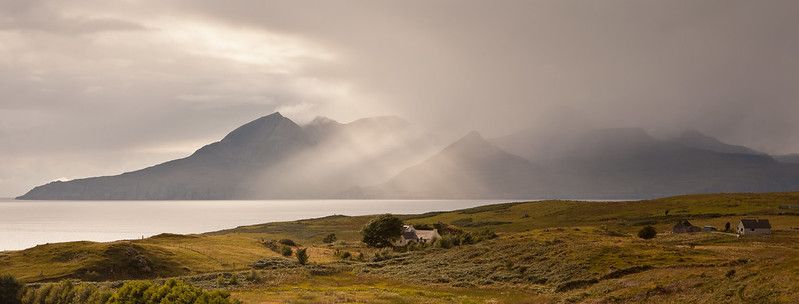
Essex | Numbers of dunlins and dark-bellied brent geese have soared on Northey Island after the overhead power lines were rerouted underground, according to the National Trust. The island sits in the Blackwater Estuary, and both species overwinter there while migrating from northern Scandinavia and Russia. More than 3,800 dunlins were recorded in January, a ten percent increase on the previous record. The lines were removed as part of a project to create around 60 hectares of new healthy saltmarsh habitat around the coast. The initiative, according to ranger David Mason, “has opened up a large section of the island and created improved landing areas for the birds for feeding and resting during their annual migrations.” The Telegraph reported the story.
Elsewhere:
- A restoration project in Wansbeck has received £600,000 to sample trees, shrubs and soil to assess how various habitats store carbon, reports the BBC.
- An offshore wind developer has pledged £50,000 to support the Lowestoft Kittiwake Partnership, which helps kittiwakes nest safely in the town.
- A wildfire that burned a Glenuig hillside in April is estimated to be the second largest fire in the UK in over a decade, reports the Herald.
- A volunteer from Buchlyvie was named one of 500 ‘Coronation Champions’ for her work to conserve red squirrels, reports the Herald.
- Members of the National Trust feel “more prepared” for avian flu on the Farne Islands this year, reports the Guardian.
- A pair of peregrine falcons nesting at Leicester Cathedral have hatched three chicks, reports the Leicester Mercury.
- A humpback whale washed up on the sand banks in Loch Fleet nature reserve could have died due to entanglements with creel lines, reports the BBC and the Herald. Elsewhere, a sperm whale was washed up at Porth Neigwl in north Wales, and a second minke whale on North Berwick beach. In Yorkshire, a 30-tonne fin whale was removed after becoming a macabre tourist attraction, reports the Guardian.
- Noss Nature Reserve in Shetland has reopened to the public after closing last year due to avian flu.
- Work by the Environment Agency at Costessey, Norwich, will benefit the nationally scarce Marsh Carpet Moth and the endangered black poplar tree.
- A Community Green Grant to Froglife will allow the charity to restore a neglected area of Reedswood Park in Walsall, reports the Express & Star.
- A European nightjar, rarely found in Scotland, was handed in to a wildlife rehabilitation centre in Aberdeenshire after being found on the ground, reports BirdGuides.
- Eighteen stallions are being released into the New Forest between May and July to preserve the bloodlines of the pony, reports the BBC.
- The National Trust for Scotland has come up against local opposition over an out-of-season deer cull in Glen Coe, reports the Scotsman.
- The BBC has announced that Springwatch will return on 29 May, from a new location: RSPB Arne in Dorset. The Dorset Echo reported the news.
- The RSPB has met with farmers in north-east Scotland to discuss collaborating on conservation and soil health trials, reports the Grampian Online.
- The National Trust is planning to restore 320 hectares of woodland in Stroud, as well as introducing 100 Belted Galloway to manage the grassland, reports the BBC.
- A conservation project for curlew will begin moving the birds’ eggs to sites in Sussex, Kent and Dorset in the hope of re-establishing numbers in the wild, reports the Telegraph.
Reports
Food | WWF has released the latest iteration of its Livewell diet, designed to showcase a way of eating in the UK that would reduce the emissions of the farming sector while also cutting its impact on nature, and being socially acceptable, healthy and affordable. The diet is plant-rich, includes a moderate amount of dairy and eggs, and prioritises lower-footprint seafood. Our current diet equates to 4.84 kilograms of CO2 equivalent per person per day; the Livewell diet would reduce that to 3.12kg – although that is still some way off the IPCC’s 2030 target of 2.04kg. The report is clear that this transformation cannot only be the responsibility of the individual, and includes information on how governments and businesses can help to create the change required.
Farming | The current system of agricultural funding in Scotland is fuelling the biodiversity and climate crises and risking food security, according to a report by campaign coalition Farm for Scotland’s Future. Backed by 40 environment and food organisations, the report argues that the agricultural funding system is unfair and inefficient, with the top 20% of claimants receiving 62% of the budget for direct payments. Deborah Long, Chief Officer at the Scottish Environment LINK, explained: “The current, decades-old system rewards land ownership, rather than good land use, and is failing to help the farmers who want to produce food while protecting the environment.” Instead, the authors suggest that the upcoming Agriculture Bill is an opportunity to radically rethink the system, and incentivise farming methods which prioritise climate and nature alongside food production. The Herald covered the report.
Europe | The European Environment Agency has released a briefing on the importance of restoring nature in Europe. Currently, across the EU, 81% of protected habitats, 39% of protected birds and 63% of other protected species are in a poor or bad state, and only a small fraction of these have shown any improvement in recent years. There are myriad benefits to restoration, including increasing carbon sequestration and improving the wellbeing of people. The report is not particularly detailed, but is nonetheless a useful overview of the current state of play, and includes a useful infographic breaking down the condition of different habitats across the member states.
Science
Hen harriers | A study led by the RSPB, and published in Biological Conservation, paints a grim picture of the chances of survival for hen harriers on grouse moors. The researchers analysed data from 148 birds tracked in Britain between 2014 and 2021. They found that annual survival was low, with illegal killing accounting for 75% of mortality in subadult birds, with the babies typically surviving for just 121 days after fledging. A 10% increase in grouse moor use resulted in a 43% increase in mortality risk, and the timing of the deaths peaked around the shooting season and during breeding territory establishment. “Governments have failed to reduce illegal killing of Hen Harriers and other raptors in Britain and our results emphasise that further legislative reform is needed to tackle this enduring criminality,” the authors concluded. The findings were summarised by the RSPB, and the Herald covered the study.
Gamebirds | The release of gamebirds has diverse impacts – positive and negative – on other non-game species, according to a study published in Ecology and Evolution. Researchers compared biodiversity records for areas where the birds had been released with those where they had not. They found that rodents, grey squirrels, butterflies and farmland birds benefited in release sites, while foxes, beetles and woodland birds suffered. There were no impacts on reptiles, buzzards, ravens, jays or magpies. While the data is crude, the study lifts a lid on the impacts of shooting beyond individual species or sites. The findings, conclude the authors, “should alert practitioners, opponents, and legislators that a focus on single taxa effects, either positive or negative, may obscure the simultaneous changes in other taxa.”
Driftwood
Birds | How have bird populations changed in your local area since 1970? A new interactive tool from the British Trust for Ornithology (BTO) means that you can now find out. Enter your postcode, and the website will show you which species have been lost from your immediate surroundings, as well as those that are declining, increasing and colonising. The findings are based on numerous sources of information, pieced together with “a degree of detective work”. Unsurprisingly, the overall picture is an unhappy one: the UK is home to 73 million fewer breeding birds today than it was fifty years ago. This figure hides the sheer scale of the loss, as some declines have been replaced by gains in other populations, including wrens and woodpigeons.
But what does this loss look like? My attempt to visualise it: each bird represents 1 million pairs - many more (57) fade out than are replaced (21). Thanks to all @_BTO #volunteers whose observations provide evidence for action👉https://t.co/zza1JqQXlw #ornithology #conservation https://t.co/kfWjncW2hL pic.twitter.com/e0KLY84Cph
— Rob Robinson (he/him) 🏴🇪🇺 (@btorobrob) May 8, 2023
Tolkien | A research team that discovered a rare genus of butterfly has named it after Sauron, the evil ruler in Tolkien’s Lord of the Rings. The moniker was inspired by the butterfly’s striking appearance, with eye-like markings on the wings in vivid orange and black recalling the all-seeing eye from the books. Blanca Huertas of the Natural History Museum explained that the team hoped to pique the public’s interest: “By giving [new species] unusual names we can bring attention to what is happening to butterflies, which are in real trouble across the world today.” Only two species of the genus Saurona have been discovered so far, but the team think there are many more in the wild. The Guardian and the BBC covered the story.
Forests | A survey by Forestry and Land Scotland has found that almost four in ten people have witnessed or taken part in behaviour that might have been harmful to wildlife in Scotland’s forests. FLS released the survey results to coincide with the launch of their campaign, ‘Protect Scotland’s Wildlife’. The survey also found that, although nine in ten Scots visit one of Scotland’s national forests to take part in outdoor activities, 59% are unaware of the breeding and nesting seasons of birds and other wildlife in the areas they visit. The campaign is launching to coincide with the start of the main breeding and nesting season, and aims to highlight the unintended consequences of certain activities, especially as people increasingly seek places off the beaten track. The Herald and Yahoo News covered the research.
Further reading:
- An ancient pine tree in the Cambridge University Botanic Garden was lit up using kinetic power from bicycles as part of coronation celebrations, reports the BBC.
- An article in the Darlington and Stockton Times features the publication of Teesdale botanist Margaret Bradshaw’s book. You can find Inkcap Journal’s feature on the legendary lady here.
- A blog by the British Ornithologists' Union digs into research on the impact of lead on wild birds.
- A feature by BBC Culture looks at six extraordinary gardens from around the world, including one in Dungeness, Kent.
- A series of articles in the Herald examines the impacts of wildfires in Scotland, and how climate change could exacerbate them.
- An article in the Scotsman takes an in-depth look at the Wildlife Management and Muirburn Bill.
- Find out how birdwatching can boost your wellbeing, in this blog from Forestry England.
- A blog by the Sussex Wildlife Trust explores how hedges are “more than just a boundary”.
- Devon Wildlife Trust is inviting the public to submit their opinions on reintroducing pine martens to the southwest.
- A photography feature in the Times showcases the best wildlife images from 100 photographers across the globe.
- In the Conversation, an article explores how getting out into nature can help people struggling with drug and alcohol problems.
Happy days
Illustration | Renowned illustrator Sir Quentin Blake, who brought many of Roald Dahl’s books to life, has teamed up with the Wildfowl and Wetlands Trust to inspire new connections with nature. In the project ‘Drawn to Water’, 54 of Sir Quentin’s drawings will accompany the launch of three seasonal trails in Stroud, Gloucestershire, designed to highlight the best of the UK’s wetland nature. Sir Quentin said the project aimed “to inspire all ages and abilities, helping everyone experience nature in new, unexpected ways.” The BBC reported the story.

Subscribe to our newsletter
Members receive our premium weekly digest of nature news from across Britain.
Comments
Sign in or become a Inkcap Journal member to join the conversation.
Just enter your email below to get a log in link.